The Architecture of Anti-Fashion: Inside the World of Comme des Garçons
Posted by commedes Garcons
Filed in Shopping 86 views
Comme des Garçons
In 1981, a seismic wave hit the Parisian fashion establishment. At a time when high fashion was defined by ultra-glamorous, body-conscious silhouettes, opulent silks, and razor-sharp Western tailoring, a Japanese designer named Rei Kawakubo presented a collection that looked like an act of open rebellion. Models walked down the runway in oversized, asymmetrical, distressed black garments, full of holes and frayed edges.
The Western press, bewildered and slightly horrified, labeled the aesthetic "Hiroshima Chic" or "The Rag Look." But Kawakubo wasn’t trying to evoke destruction; she was rewriting the vocabulary of clothes. This was the global debut of Comme des Garcons, a brand that would spend the next several decades challenging the very definition of beauty, gender, and wearability.
The Origin: "Like Some Boys"
Founded in Tokyo in 1969 and incorporated in 1973, Comme des Garçons (French for "Like some boys") did not start from a desire to fit into the French luxury ecosystem. Rei Kawakubo, who studied fine arts and aesthetics rather than fashion design, started making clothes simply because she couldn't find what she wanted to wear.
The name itself was chosen not for a profound philosophical reason, but because Kawakubo liked the sound of the French words. Yet, it became wildly prophetic. CDG dismantled the traditional, hyper-feminized silhouettes of the era. Instead of designing clothes that accentuated the female body for the male gaze, Kawakubo created garments that ignored, obscured, or entirely refabricated the human form.
Deconstruction and the Beauty of Imperfection
At the core of the Comme des Garçons ethos is the Japanese philosophy of Wabi-Sabi—finding beauty in imperfection, impermanence, and incompletion. Kawakubo turned this into a design methodology.
Key Design Pillars of CDG
-
Asymmetry: Clothes with uneven hems, off-center buttons, and single sleeves.
-
The Power of Black: In the 1980s, Kawakubo’s obsessive use of black birthed a subculture of loyal followers in Japan known as The Crows (Karasu-zoku). To her, black was not a color of mourning, but a canvas of intense focus and strength.
-
Destroyed Fabrics: Boiling wool to make it shrink, fraying edges, and intentionally introducing holes. Kawakubo famously remarked that tears and holes provided a "different kind of texture."
Perhaps the most legendary manifestation of this philosophy was the Spring/Summer 1997 "Body Meets Dress, Dress Meets Body" collection, colloquially known as the "Lumps and Bumps" collection. Kawakubo inserted down-padded bumps into stretched nylon garments, creating distorted, tumor-like silhouettes on the hips, backs, and shoulders of the models. It was a radical critique of how society forces women's bodies into unnatural shapes, offering instead an entirely new, avant-garde anatomy.
The Empire of Sub-Brands
While the main runway collection (Comme des Garçons Homme Plus and Comme des Garçons Women) remains purely avant-garde, Kawakubo and her husband, Adrian Joffe (the CEO of the company), realized that radical art needs a commercial engine. Today, CDG is a sprawling, highly profitable empire comprised of over two dozen sub-brands, each catering to a distinct demographic. comme-desgarcons.uk
| Brand Line | Aesthetic Focus | Target Audience |
| Comme des Garçons (Main Line) | High avant-garde, conceptual, runway pieces. | Collectors, museums, fashion purists. |
| Comme des Garçons SHIRT | Reimagining and deconstructing the classic button-down. | Creative professionals, luxury casual wearers. |
| Comme des Garçons BLACK | Accessible, mostly black archival reissues and basics. | Streetwear enthusiasts. |
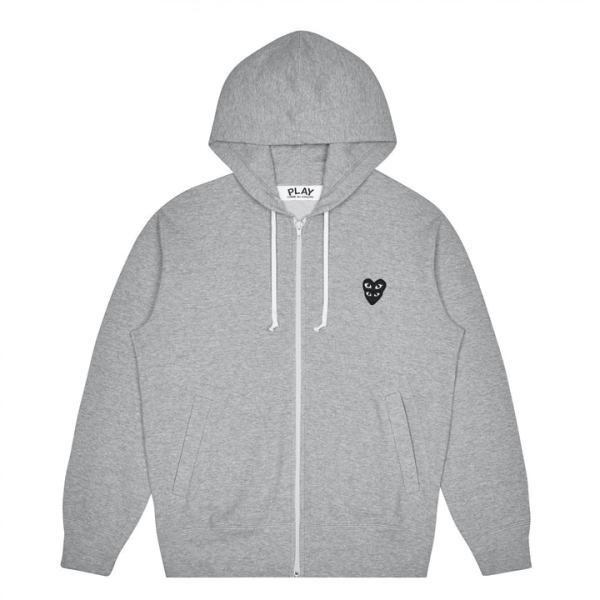
| PLAY Comme des Garçons | Streetwear basics (T-shirts, hoodies, Converse collabs). | Mass market, youth culture. |
The PLAY line, featuring the iconic heart logo with two eyes designed by Polish artist Filip Pagowski, is arguably the brand's most recognizable asset. It serves as the gateway drug for the masses, funding the boundary-pushing, financially risky main-line runway shows.
Dover Street Market: Retail as Art
You cannot understand Comme des Garçons without understanding how they sell. In 2004, Kawakubo and Joffe opened Dover Street Market (DSM) in London, a multi-brand concept store that revolutionized retail.
Described by Kawakubo as a "beautiful chaos," DSM strips away the sterile, intimidating atmosphere of traditional luxury boutiques. It mixes high fashion with streetwear, displaying CDG alongside competitors like Gucci, Prada, Supreme, and emerging young designers. The spaces double as art galleries, with changing installations, chaotic scaffolding, and no distinct boundaries between brands. It proved that shopping could be an immersive, cultural experience.
A Breeding Ground for Genius
Kawakubo’s legacy is also defined by her unmatched mentorship. Unlike many creative directors who fiercely guard their domains, Kawakubo has fostered an environment where her protégés can thrive under her umbrella before launching their own global brands.
The most notable of these is Junya Watanabe, who started as a patternmaker at CDG and now runs his own highly successful lines under the CDG corporate structure. Similarly, Chitose Abe (founder of Sacai) and Kei Ninomiya (Noir Kei Ninomiya) cut their teeth at Comme des Garçons, absorbing the ethos of relentless innovation before spinning off their own distinct creative visions.
Conclusion: The Eternal Avant-Garde
In an era where fashion is increasingly driven by algorithms, viral social media moments, and corporate homogenization, Comme des Garçons stands as a monolith of pure creative independence. It remains privately owned, allowing Kawakubo—well into her eighties—uncompromised freedom to create.
Comme des Garçons is not just a clothing brand; it is a lifelong philosophical inquiry into what it means to be human, to dress, and to rebel. By rejecting the traditional rules of symmetry, glamour, and gender, Rei Kawakubo didn't just change the clothes we wear—she changed the way we look at the world.