Supplier Collaboration as a Foundation for Agile Retail Operations
Posted by Dhara Panwar
Filed in Business 41 views
Retail has entered an era where speed, flexibility, and responsiveness are critical competitive advantages. Consumer preferences shift rapidly, demand patterns fluctuate unexpectedly, supply chain disruptions occur more frequently, and new products enter the market at an accelerating pace. In this environment, retailers can no longer rely solely on traditional operational models built around fixed plans and isolated decision-making.
To remain competitive, retailers must develop agile operations that can respond quickly to changing market conditions while maintaining product availability and operational efficiency. Achieving this level of agility requires more than internal process improvements. It depends on strong collaboration across the entire supply chain, particularly with suppliers.
Suppliers play a vital role in inventory availability, replenishment performance, product launches, forecasting accuracy, and overall supply chain responsiveness. When retailers and suppliers operate in silos, delays, misalignment, and inefficiencies can limit the ability to respond to changing customer demand. Conversely, organizations that collaborate closely with suppliers can improve visibility, accelerate decision-making, and build more adaptive supply chains.
As retail operations become increasingly complex, supplier collaboration is emerging as a foundational element of operational agility and long-term business success.
Understanding Agile Retail Operations
Agile retail operations refer to the ability of a retailer to respond quickly and effectively to changing market conditions, customer demand, and supply chain disruptions.
Agility enables organizations to:
- Adjust inventory plans rapidly
- Respond to demand fluctuations
- Launch products faster
- Manage disruptions effectively
- Improve customer experiences
The goal is to create operational flexibility without sacrificing efficiency.
Why Agility Has Become Essential in Retail
Retail environments are becoming increasingly unpredictable.
Several factors contribute to this complexity:
Changing Consumer Preferences
Customer interests can evolve rapidly due to trends, social influence, and market conditions.
Omnichannel Commerce
Retailers must support inventory availability across stores, ecommerce channels, and fulfillment networks.
Supply Chain Volatility
Transportation delays, raw material shortages, and geopolitical disruptions can affect inventory flow.
Shorter Product Lifecycles
Products often move through their lifecycle faster than in the past.
Competitive Market Dynamics
Retailers must respond quickly to competitor actions and emerging opportunities.
These challenges require more agile operational models.
The Role of Suppliers in Retail Agility
Suppliers influence nearly every aspect of retail operations.
They contribute to:
- Inventory availability
- Replenishment cycles
- Product launches
- Forecast execution
- Supply continuity
Without effective supplier coordination, even the most sophisticated retail strategies can struggle to succeed.
This makes collaboration essential for operational agility.
Understanding Supplier Collaboration
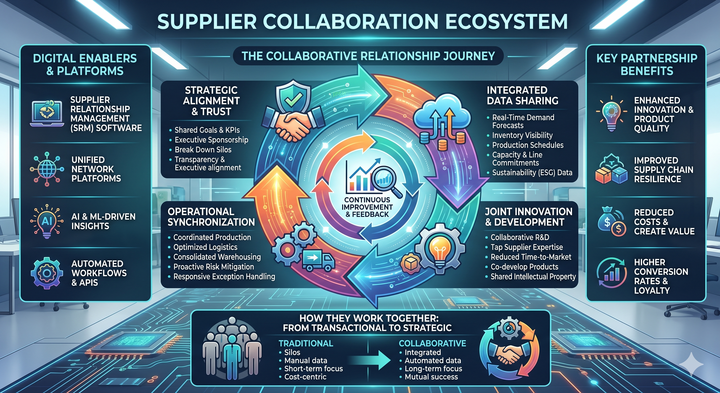
Supplier collaboration involves retailers and suppliers working together to improve planning, forecasting, inventory management, replenishment, and operational execution.
Rather than operating through transactional interactions alone, collaborative relationships focus on:
- Shared objectives
- Information transparency
- Joint planning
- Coordinated decision-making
- Continuous improvement
The objective is to improve outcomes for both parties while enhancing customer experiences.
Why Traditional Supplier Relationships Limit Agility
Historically, many supplier relationships focused primarily on:
- Purchase orders
- Pricing negotiations
- Delivery schedules
- Contract management
While these activities remain important, they often create challenges such as:
- Limited visibility
- Delayed communication
- Forecast misalignment
- Slow response times
These limitations can hinder a retailer's ability to react quickly to changing conditions.
How Supplier Collaboration Supports Agile Retail Operations
Improving Supply Chain Visibility
Visibility is one of the most important drivers of agility.
Collaborative relationships enable retailers and suppliers to share:
- Inventory levels
- Demand forecasts
- Production schedules
- Shipment status
- Replenishment plans
This shared visibility allows both parties to anticipate changes and respond proactively.
Enabling Faster Decision-Making
Retail agility depends on timely decisions.
Supplier collaboration improves decision speed by ensuring all participants have access to relevant information.
When demand changes occur, retailers and suppliers can respond quickly with coordinated actions.
This reduces delays and improves operational responsiveness.
Supporting Collaborative Forecasting
Forecast accuracy is critical for agile operations.
Collaborative forecasting allows retailers and suppliers to share:
- Demand projections
- Promotional calendars
- Sales trends
- Market insights
This improves planning accuracy and helps suppliers prepare for changing demand.
Better forecasts reduce both inventory shortages and excess inventory.
Strengthening Replenishment Agility
Replenishment planning becomes more effective when suppliers have visibility into retailer demand and inventory conditions.
Collaborative replenishment enables suppliers to:
- Adjust production schedules
- Prioritize inventory allocation
- Respond to demand spikes
This improves product availability and replenishment responsiveness.
Responding Faster to Demand Changes
Consumer demand can shift unexpectedly.
Examples include:
- Viral product trends
- Seasonal demand spikes
- Promotional events
- Economic changes
Supplier collaboration enables retailers to communicate demand shifts quickly and coordinate replenishment actions.
This supports faster adaptation to market conditions.
Enhancing Inventory Flexibility
Agile retailers need the ability to reposition inventory as conditions change.
Supplier collaboration helps support:
- Inventory reallocation
- Replenishment adjustments
- Demand-driven inventory planning
This flexibility improves inventory productivity and customer service levels.
Managing Supply Chain Disruptions More Effectively
Disruptions have become a regular feature of modern supply chains.
Examples include:
- Transportation delays
- Supplier capacity issues
- Raw material shortages
- Weather-related disruptions
Collaborative supplier relationships improve risk visibility and accelerate response efforts.
This strengthens operational resilience.
Supporting Faster Product Launches
Product innovation requires close coordination between retailers and suppliers.
Collaboration helps align:
- Production schedules
- Inventory requirements
- Distribution plans
- Launch timelines
This improves execution and accelerates time-to-market.
Leveraging Real-Time Data for Operational Agility
Modern collaboration platforms enable real-time information sharing.
Retailers and suppliers can access:
- Inventory updates
- Demand signals
- Order status
- Supply constraints
Real-time visibility improves responsiveness and decision quality.
AI and Predictive Analytics Enhance Collaboration
Artificial intelligence is increasingly supporting collaborative planning.
AI-powered solutions can:
- Predict demand changes
- Identify supply risks
- Recommend inventory actions
- Optimize replenishment decisions
These insights help retailers and suppliers make proactive decisions together.
Building Trust Across the Supply Chain
Trust is a critical component of agile operations.
Organizations that share information openly and work toward common goals often develop stronger partnerships.
Trust enables:
- Faster communication
- Better problem-solving
- Greater operational flexibility
- Improved long-term performance
Strong relationships support stronger ecosystems.
Benefits of Supplier Collaboration for Retail Agility
Faster Response to Market Changes
Organizations can adapt more quickly to evolving demand.
Improved Product Availability
Collaborative planning supports inventory continuity.
Better Forecast Accuracy
Shared insights improve planning performance.
Reduced Supply Chain Risk
Greater visibility enables earlier intervention.
Increased Inventory Efficiency
Coordinated replenishment improves productivity.
Enhanced Customer Satisfaction
Reliable availability supports better customer experiences.
Common Challenges Organizations Face
Data Silos
Information may remain fragmented across systems.
Technology Integration Complexity
Connecting supply chain partners can be challenging.
Cultural Resistance
Organizations may hesitate to share operational data.
Process Misalignment
Retailers and suppliers may operate with different priorities.
Addressing these challenges is essential for successful collaboration.
Best Practices for Supplier Collaboration
Establish Shared Objectives
Align goals across retail and supplier organizations.
Improve Data Transparency
Visibility supports faster decision-making.
Invest in Collaborative Technologies
Digital platforms enable scalable coordination.
Leverage Predictive Analytics
Advanced insights improve responsiveness.
Foster Long-Term Partnerships
Strong relationships create sustainable value.
Key Metrics to Track
Organizations should monitor:
- Forecast accuracy
- Supplier fill rates
- On-time delivery performance
- Inventory turnover
- Stockout rates
- Lead time variability
- Supply chain responsiveness
These metrics help evaluate collaboration effectiveness.
Conclusion
Operational agility has become a critical requirement for retailers operating in an increasingly dynamic and unpredictable environment. The ability to respond quickly to changing customer preferences, market conditions, and supply chain disruptions depends not only on internal capabilities but also on strong supplier relationships.
Supplier collaboration provides the visibility, coordination, and shared decision-making necessary to support agile retail operations. By improving forecasting, replenishment planning, inventory management, and disruption response, collaborative supplier ecosystems enable retailers to operate with greater speed, flexibility, and resilience.
As retail continues to evolve, organizations that prioritize supplier collaboration will be better positioned to improve operational performance, enhance customer experiences, and achieve sustainable competitive advantage.