Navigating the Complexities of Behavioral Health: Why USA Practices Are Turning to Specialized Mental Health Billing Companies
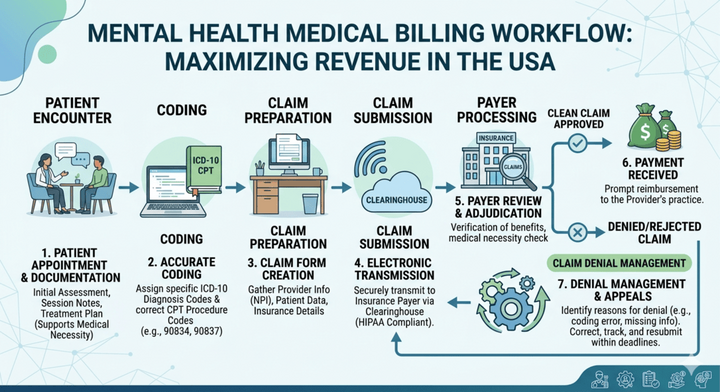
The landscape of healthcare in the USA is shifting rapidly, and perhaps no sector has experienced as profound a transformation in recent years as behavioral health. As public awareness grows and insurance coverage expands, mental health practitioners—from solo psychologists to large psychiatric clinics—are seeing a massive influx of patients. However, managing a growing practice involves a steep administrative hurdle that many providers find overwhelming: insurance reimbursement. Navigating the labyrinth of claims, copays, and specialized modifiers is vastly different for behavioral health compared to traditional physical medicine.
To keep their doors open and focus on patient care, an increasing number of providers are partnering with dedicated mental health billing companies. Unlike general billing firms, these specialized partners understand the nuanced differences of psychiatric documentation, specific tracking requirements, and the unique challenges of behavioral health reimbursement. When administrative burdens begin to detract from clinical hours, outsourcing becomes less of an operational luxury and more of a financial necessity.
For any growing practice in the USA, establishing a robust administrative foundation is critical. Beyond standard claim submissions, comprehensive medical billing services form the backbone of a clinic’s financial health, ensuring that every therapy hour, diagnostic evaluation, and crisis intervention is documented and tracked from the initial appointment to final payment collection.
The Unique Hurdles of Behavioral Health Billing
Behavioral health billing is notoriously complex. In traditional medicine, a procedure is often straightforward—an X-ray, a blood draw, or a physical exam has a highly structured, predictable reimbursement path. In mental health, however, the variables are highly fluid.
1. Time-Based Coding Vulnerabilities
Most behavioral health services are heavily dependent on time. CPT codes change based on whether a session lasts 30, 45, or 60 minutes. Miscalculating session times or failing to document the exact start and stop times can lead to immediate claim denials or, worse, severe penalties during an insurance audit.
2. Prior Authorization Pitfalls
Insurance companies frequently require prior authorizations for extended therapy blocks, intensive outpatient programs (IOP), or psychological testing. Missing a re-authorization window by even a single day can result in a string of uncollectible claims that the provider cannot legally pass on to the patient.
3. The Strict Separation of Evaluation and Management (E/M)
For psychiatrists and psychiatric nurse practitioners, balancing therapy codes with medical management codes (like medication checks) requires precise synchronization. Applying the wrong modifiers can flag a practice for irregular billing patterns, triggering manual reviews that freeze cash flow for months.
Elevating Documentation with Expert Medical Coding Services
Accurate coding is the language through which a practice communicates with insurance payers. Utilizing professional medical coding services ensures that clinical notes are perfectly translated into standardized alphanumeric formats. In mental health, this means navigating DSM-5 diagnoses and translating them accurately into ICD-10 codes, while ensuring they match the corresponding CPT code seamlessly.
[Clinical Notes] ➔ [Medical Coding Services] ➔ [Flawless Claim Submission]
When documentation is handled by certified coders who specialize in behavioral health, common errors—such as using an incorrect modifier for telehealth or failing to link a secondary substance abuse diagnosis—are eliminated before the claim ever reaches the insurance clearinghouse.
Streamlining Operations with Integrated Medical Billing and Coding Services
When a practice attempts to separate its coding from its billing workflow, details frequently slip through the cracks. True efficiency is achieved when a clinic utilizes fully integrated medical billing and coding services. This holistic approach bridges the gap between what happens in the therapy room and what is sent to the insurance companies.
An integrated system provides a clear, continuous loop:
-
Pre-Session Verification: Ensuring the patient's benefits cover mental health services before they sit down.
-
Concurrent Coding Review: Checking that the therapist's notes match the time and intensity of the selected billing codes.
-
Clean Claim Submission: Passing the claim through rigorous electronic scrubbing matrices to check for omissions.
-
Denial Management: Immediately appealing any rejected claims using specific clinical documentation.
By unifying these two critical arms, practices drastically reduce their Days in Accounts Receivable (AR) and secure a far more predictable baseline revenue.
Optimizing Financial Health: Revenue Cycle Management Services
For a modern USA healthcare practice, billing is only one piece of a much larger puzzle. To truly thrive, a clinic must optimize its entire financial lifecycle through comprehensive revenue cycle management services (RCM).
   [Patient Intake & Eligibility]
                 │
                 ▼
     [Clinical Documentation]
                 │
                 ▼
    [Charge Capture & Coding]
                 │
                 ▼
       [Claim Transmission]
                 │
                 ▼
 [Denial Management & Patient Billing]
RCM looks at the big picture. It starts the moment a patient calls to schedule their first intake assessment and doesn't end until the final balance is paid, whether by the insurance company or the individual. Effective revenue cycle management tracks metrics like clean claim rates, net collection ratios, and bad debt percentages, allowing practice owners to make informed decisions about expanding their staff or opening new locations.
The Critical Role of Credentialing Services
Before a mental health professional can bill an insurance company as an in-network provider, they must pass through the grueling process of insurance paneling. Specialized credentialing services take this massive administrative burden off the provider's shoulders.
Payer credentialing involves submitting verified histories of education, licensing, malpractice coverage, and clinical experience to every major insurance network. For a solo provider or a growing group practice, keeping up with CAQH profiles, expiration dates, and re-credentialing cycles can easily cause gaps in coverage—meaning you could provide weeks of therapy to a patient only to find out your network status had temporarily lapsed. Professional management keeps your practice compliant and continuously authorized to collect in-network reimbursements.
Selecting the Right Administrative Partner
As you look to optimize your practice’s financial workflow, finding an all-in-one partner who can manage these technical pieces seamlessly is vital. Industry leaders like 247 Medical Billing Services offer a tailored suite of administrative solutions designed specifically to alleviate the unique burdens of behavioral health practices.
By outsourcing to an expert partner, mental health clinics gain access to specialized medical billing services that keep up with changing state and federal regulations. Furthermore, their precise medical coding services dramatically cut down on documentation errors, while their unified medical billing and coding services create a friction-free path from patient intake to final payment. When coupled with advanced revenue cycle management services and proactive credentialing services, practices can finally shed the stress of administrative overhead and redirect their energy where it belongs: helping patients heal.
Frequently Asked Questions
1. Why can't I use a standard medical billing company for my mental health practice?
Standard medical billing companies often specialize in high-volume, procedure-based physical medicine. They may lack deep familiarity with behavioral health nuances, such as time-based CPT codes, interactive complexity modifiers, and the specific documentation required to appeal mental health claim denials.
2. What are the most common reasons mental health insurance claims are denied?
The majority of mental health claim denials stem from a few recurring issues: missing or expired prior authorizations, mismatched session times and CPT codes, incorrect patient demographic information, and failing to verify whether behavioral health benefits are carved out to a separate third-party payer.
3. How do professional coding services protect my practice during an audit?
Professional coders ensure your clinical documentation thoroughly supports the specific levels of service you are billing. By maintaining strict compliance with ICD-10 and CPT guidelines, they protect your practice from over-coding (which triggers fraud audits) and under-coding (which leaves hard-earned money on the table).
4. How long does the insurance credentialing process typically take in the USA?
Insurance credentialing is notoriously slow, generally taking anywhere from 90 to 180 days per commercial insurance panel. Utilizing dedicated credentialing services speeds up this timeline by ensuring applications are flawless on the first submission and by systematically following up with payer network managers.