What Sets( برنامج محاسبة)Apart from Traditional Accounting 2026?
Posted by Accounting Software
Filed in Technology 40 views
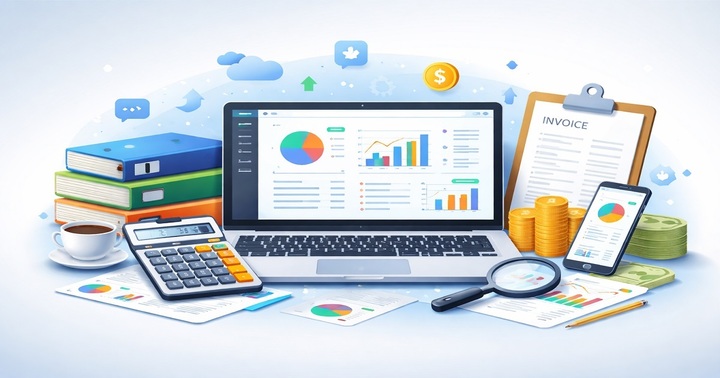
Accounting has always been central to business management, but the way companies handle financial information is changing rapidly. Saudi businesses increasingly need faster reporting, better financial visibility, stronger controls, and more efficient workflows. Traditional accounting methods can struggle to meet these expectations as transaction volumes and business complexity increase. A modern برنامج محاسبة provides a digital alternative that can transform how financial activities are recorded, monitored, and analyzed.
For businesses in Saudi Arabia, a برنامج محاسبة can bring financial transactions, invoices, expenses, payments, and reports into a centralized environment. Instead of depending on paper documents, disconnected spreadsheets, and repetitive calculations, businesses can create more organized accounting workflows. This difference becomes particularly important in 2026, when companies need technology that supports both daily financial operations and long-term business growth.
Understanding Traditional Accounting Methods
Traditional accounting often depends on spreadsheets, physical documents, calculators, and manually maintained records. These methods can work for very small businesses with limited transactions.
However, financial processes become more complicated as a company grows. More customers, suppliers, employees, invoices, and expenses create additional administrative requirements.
Accounting staff may need to enter the same information multiple times. Managers may also wait for manually prepared reports before understanding current financial performance.
This can limit the speed and accuracy of financial decision-making.
What Is a Modern Program محاسبة?
A modern accounting program is a digital system designed to organize financial transactions and accounting activities.
It can help businesses record sales, purchases, expenses, payments, invoices, receivables, payables, and other financial information within a centralized platform.
Depending on the solution, businesses may also receive reporting, tax-related features, inventory integration, budgeting tools, and multi-branch functionality.
The main difference is not simply that information becomes digital. The system can connect financial processes so they work together more efficiently.
Centralized Financial Data
One of the biggest differences between digital and traditional accounting is data centralization.
Traditional methods often store information across different spreadsheets, folders, and documents. Finding a specific transaction may require searching through multiple sources.
A digital accounting platform creates a central financial environment. Authorized users can access relevant records from one location.
This makes financial information easier to manage and reduces the risk of inconsistent records.
Centralization also gives management a clearer picture of business activity.
Faster Transaction Recording
Traditional accounting can require repeated manual entries. Employees may record a transaction in one document and then enter related information elsewhere.
This consumes time and increases the possibility of errors.
A modern accounting system can automate or simplify transaction recording. Once information is entered into the appropriate workflow, related financial records can be updated according to the system's configuration.
This improves efficiency and reduces unnecessary repetition.
Improved Accounting Accuracy
Manual calculations are vulnerable to human error. A misplaced decimal, incorrect formula, or duplicated entry can affect financial results.
Accounting software can perform many routine calculations automatically. This reduces the need for repeated manual calculations.
Digital validation and structured workflows can also help identify incomplete or inconsistent information.
Although professional review remains essential, automation provides stronger support for accurate accounting.
Real-Time Financial Visibility
Traditional accounting often relies on periodic reporting. Management may receive financial information after accountants have completed manual calculations and prepared reports.
This delay can make it difficult to respond quickly to changing business conditions.
A digital accounting platform can provide more current information based on recorded transactions.
Managers can review financial activity more frequently and make decisions using information that is closer to the current business position.
This improved visibility is one of the most valuable differences between modern and traditional accounting.
Automated Financial Reporting
Financial reporting is essential for understanding business performance. Traditional reports can require significant manual preparation.
Accountants may need to collect information from multiple files, verify calculations, and prepare tables before presenting results.
A digital accounting system can organize transaction data for faster report generation.
Businesses can review financial statements, expense summaries, sales information, and other reports according to available system features.
This saves time and allows accountants to focus more on interpreting financial information.
Simplified Invoice Management
Invoice management can become difficult when businesses handle numerous customers and suppliers.
Traditional methods may involve creating invoices manually and tracking payments through spreadsheets.
A modern accounting program can organize invoice creation and payment tracking within a connected workflow.
Businesses can monitor outstanding invoices and identify payment activity more easily.
This can improve accounts receivable management and support healthier cash flow.
Better Expense Control
Expense management is another area where digital accounting creates significant advantages.
Traditional systems may require employees to collect receipts and manually enter expense information. This can make it difficult for management to understand spending patterns quickly.
A digital platform can categorize expenses and maintain organized records.
Managers can review costs according to categories, departments, branches, or other available criteria.
Better visibility can help businesses identify unnecessary spending and improve financial control.
Stronger Cash Flow Management
Cash flow determines whether a business can meet its short-term financial obligations.
Traditional accounting methods may provide useful historical information but can make current cash flow visibility difficult.
Digital accounting systems can organize receivables, payables, expenses, and payment records in one environment.
This allows businesses to understand expected incoming and outgoing funds more effectively.
Better cash flow visibility can support more informed payment and investment decisions.
Supporting VAT and Financial Compliance
Saudi businesses need to maintain appropriate financial records and meet applicable VAT and tax requirements.
Traditional accounting can make compliance documentation more time-consuming when records are scattered across different sources. A digital accounting platform can organize sales, purchases, invoices, and tax-related information.
Businesses should configure their accounting systems according to current Saudi requirements and obtain professional advice when necessary.
Multi-Branch Financial Management
Traditional accounting can become particularly challenging for businesses with multiple branches. A suitable accounting system can provide centralized visibility across multiple locations. Management can review branch performance while maintaining an overall financial view.
This can simplify consolidation and improve coordination between branches. For growing Saudi businesses, multi-location support can be an important advantage.
Improved Accounts Receivable Tracking
Customer payments can significantly affect business liquidity. A modern accounting platform can track customer invoices, outstanding balances, and payment activity in a centralized environment.
A modern برنامج محاسبة creates a more connected financial environment. It can centralize transactions, automate calculations, improve reporting, streamline invoice management, support cash flow visibility, organize VAT-related records, and connect accounting with other business functions.
For Saudi businesses in 2026, these capabilities can provide a meaningful competitive advantage. Digital accounting gives organizations faster access to financial information while reducing repetitive administrative work. When combined with professional accounting expertise and strong financial controls, the right accounting program can create a more accurate, scalable, and efficient foundation for business growth.
Frequently Asked Questions
What makes برنامج محاسبة different from traditional accounting?
It centralizes financial information, automates routine calculations, improves reporting, and reduces dependence on manual accounting processes.
Can a برنامج محاسبة improve financial accuracy?
Yes. Automated calculations and structured workflows can reduce common manual data entry and calculation errors.
Does digital accounting help Saudi businesses with VAT records?
It can organize relevant sales, purchase, invoice, and tax information when configured according to applicable Saudi requirements.
Can accounting software manage multiple branches?
Yes. Suitable accounting platforms can provide centralized financial visibility across multiple branches.
Does accounting software replace accountants?
No. It supports accountants by reducing repetitive work and giving them better tools for financial analysis and control.