The Hidden Hydraulic Flow Problem: Why Your 20-Ton Excavator Can't Break Rock Despite the Right Breaker
Posted by Desi Machines
Filed in Business 46 views
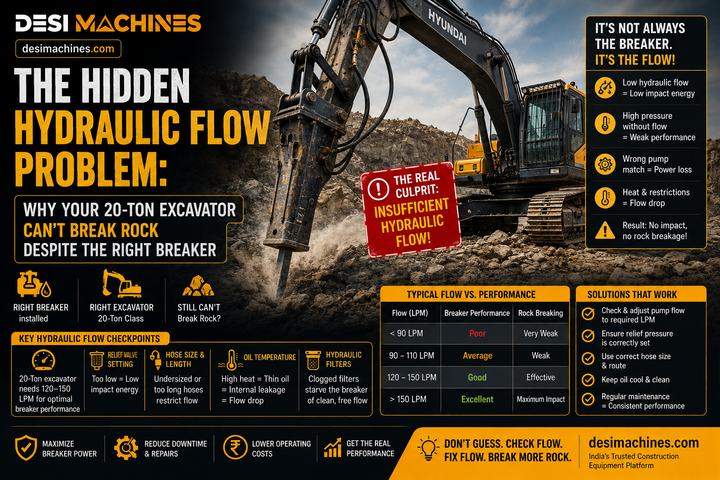
A quarry operator in Rajasthan bought a hydraulic breaker sized correctly for his 20-ton excavator by weight class. The dealer confirmed the fit. The machine had the right auxiliary circuit. The breaker was mounted, the operator started working, and within two weeks the complaint was consistent: the breaker was bouncing on the rock face rather than penetrating, cycle times were slow, and the machine was overheating by midday.
The breaker was not the problem. The hydraulic flow was.
Hydraulic breaker excavator compatibility is not a single check. It is a three-way matching exercise between the breaker's operating requirements, the excavator's auxiliary hydraulic output, and the circuit configuration between them. Getting two of the three right and missing the third produces exactly the outcome the Rajasthan quarry operator experienced: a correctly specified breaker performing far below its rated capability on a machine that should have been able to run it.
Understanding Why Flow Rate Matters More Than Pressure
Most contractors and dealers checking breaker attachment hydraulic flow rate requirements focus on operating pressure. The breaker needs 160 bar. The excavator delivers 180 bar. The check passes. The machine goes to work.
Operating pressure is a necessary condition for breaker operation. It is not sufficient. The second variable is volumetric flow rate, measured in litres per minute. A breaker that requires 120 litres per minute of hydraulic oil flow to operate at rated energy output will underperform on an excavator delivering only 80 litres per minute through the auxiliary circuit, regardless of whether the pressure specification matches.
The reason is mechanical. A hydraulic breaker's impact energy per blow is determined by how quickly the piston inside the breaker can be driven to full stroke and returned. Higher oil flow drives faster piston cycling at the same pressure. Insufficient flow produces slower piston cycling, lower impact energy per blow, and the characteristic bounce-on-surface symptom that indicates the breaker is not penetrating the rock before the piston retracts.
How to Find the Actual Flow Rate the Excavator Delivers in Breaker Mode
The rated pump flow capacity of a 20-ton excavator is not the same as the auxiliary circuit flow the machine delivers to a breaker attachment. Most 20-ton excavators in India have primary hydraulic pumps producing a 200 to 260 litres per minute total flow. That total flow powers boom, arm, bucket, swing, and travel simultaneously.
In breaker mode, the machine routes hydraulic flow through the auxiliary circuit at a reduced and controlled rate. The actual flow available to the breaker in standard single-pump auxiliary mode on most 20-ton machines runs 80 to 130 litres per minute depending on machine model and circuit configuration. Some machines offer a two-pump combined flow mode for breaker operation that increases auxiliary flow to 160 to 200 litres per minute.
Excavator breaker sizing guide India conversations should start with the operator's manual page covering auxiliary hydraulic specifications, specifically the section covering breaker mode flow rate, not the general pump specification. These numbers are different and the difference determines whether a breaker runs at rated energy or underperforms.
The Three Breakers and Why Only One Actually Fits
Consider a 20-ton excavator delivering 100 litres per minute in standard auxiliary breaker mode. Three breakers of different sizes all marketed as suitable for 20-ton class machines might carry the following flow requirements.
A light breaker requiring 60 to 90 litres per minute runs within the machine's flow capacity in standard mode. It delivers its rated energy output consistently. However, the impact energy is lower than what the machine could support, meaning rock breaking performance is adequate for medium-hard rock but slow on granite or basalt.
A medium breaker requiring 100 to 120 litres per minute operates at the edge of the machine's standard auxiliary flow. On good days with fresh hydraulic oil at operating temperature, performance is near rated. As the shift extends and oil temperature rises, pump efficiency drops and actual flow falls. The breaker starts bouncing in the afternoon on the same rock it broke cleanly in the morning.
A heavy breaker requiring 140 to 160 litres per minute exceeds the machine's standard auxiliary flow capacity entirely. In single-pump mode, this breaker underperforms consistently. On machines with two-pump combined flow capability, the heavy breaker runs correctly. On machines without this capability, the heavy breaker creates exactly the Rajasthan quarry scenario: a correctly specified breaker by weight class that performs poorly because the flow matching was never done.
Rock Breaker Performance Quarry India: The Application Adds Another Variable
Rock breaker performance in quarry India conditions adds a layer that standard breaker sizing guides do not account for. Quarry rock in Rajasthan's granite zones and Karnataka's basalt regions requires sustained high-impact energy for penetration. The breaker must penetrate the rock surface on every blow. Any bounce, any surface skating, any blow that fails to penetrate transfers the full impact energy back into the breaker body and the excavator's hydraulic system rather than into the rock.
Sustained blank firing, where the breaker cycles without penetrating the rock, is the single fastest way to destroy a hydraulic breaker. The piston cycles without resistance, speed increases beyond rated parameters, and internal component stress spikes dramatically with every blank-firing cycle.
Breaker attachment hydraulic flow rate requirements for quarry applications should therefore be matched at the higher end of the breaker's specified flow range rather than the midpoint. A breaker specified at 100 to 130 litres per minute should be matched to an excavator delivering at least 120 litres per minute in breaker mode for quarry granite or basalt, not the 100 litre minimum.
The Circuit Configuration Problem That Overheating Reveals
The midday overheating in the Rajasthan quarry case was the second symptom after bounce-on-surface and the more diagnostic one. Hydraulic oil temperature rising sharply during breaker operation points to one of two circuit problems.
The first is flow restriction. If the auxiliary circuit lines, fittings, or quick-connect couplings are undersized for the flow the pump is delivering, oil velocity increases and heat generation rises. Standard 1-inch auxiliary circuit fittings on many 20-ton machines restrict flow to approximately 80 litres per minute before pressure drop and heat generation become problematic. Some heavier breakers require 1.25 or 1.5-inch circuit lines to handle their rated flow without heat buildup.
The second is back-pressure at the return line. A breaker generating return flow faster than the return circuit can handle creates backpressure that generates heat and reduces the effective pressure differential driving the piston. Checking return line size and the hydraulic oil cooler capacity for breaker operation specifically identifies this problem before it becomes a hydraulic system failure.
Hydraulic breaker excavator compatibility done properly covers the pressure specification, the flow rate matching, and the circuit line sizing. All three must match. Missing any one of them produces underperformance at best and hydraulic system damage at worst.
FAQs
Q1. How do you find the auxiliary hydraulic flow rate specification for a specific excavator model?
The auxiliary hydraulic specifications, including breaker mode flow rate and operating pressure, appear in the excavator's operator manual and service manual under the hydraulic system section. The dealer's service department can also provide this data for specific machine serial numbers. Do not rely on general model specifications since flow rate in breaker mode varies between configuration variants of the same model.
Q2. Why does breaker performance drop in the afternoon even when it was working well in the morning?
Hydraulic oil temperature affects pump volumetric efficiency. As oil temperature rises through the shift, the pump delivers slightly less flow at the same speed. On a machine operating near its auxiliary flow limit, this afternoon efficiency drop is enough to push the breaker below its minimum flow requirement. Machines with well-maintained cooling systems and fresh hydraulic oil maintain pump efficiency through the full shift better than machines with degraded coolers or aged hydraulic oil.
Q3. Can a breaker be too small for a 20-ton excavator?
Yes. A breaker significantly undersized for the excavator's hydraulic output wastes the machine's available energy. The piston cycles too fast for the breaker body's internal geometry, impact energy is lower than the machine could deliver, and component wear inside the breaker increases because the piston is returning before the return oil has fully cleared the circuit. Breaker sizing guides in India typically express this as a minimum machine weight for each breaker model rather than a maximum.
Q4. What is blank firing and why is it damaging?
Blank firing occurs when the breaker cycles without the chisel tip contacting solid rock, usually when the tool breaks through a rock face or loses contact during operation. Without the resistance of solid rock to absorb the piston's energy, the piston impacts the breaker's internal stop at full speed. The energy that would have transferred to the rock instead transfers directly to the breaker's internal components. Sustained blank firing significantly accelerates internal wear and can cause sudden failure of the through-bolts or buffer system that holds the breaker together.
Q5. Does the quick-connect coupling size affect breaker performance?
Yes, significantly. Quick-connect couplings that are undersized for the breaker's required flow rate create a flow restriction that reduces delivered flow below what the circuit lines alone could provide. Many contractors using standard 3/4-inch quick-connect couplings on breakers requiring 120-plus litres per minute are limiting their breaker's performance through the coupling rather than the pump or circuit lines. Verifying that coupling size matches the breaker's flow requirement is the last check in a complete hydraulic breaker excavator compatibility assessment.