Outsource Healthcare Services to Pakistan: A Guide for US, UK & Global Businesses
Posted by InLinkers CXs
Filed in Health 31 views
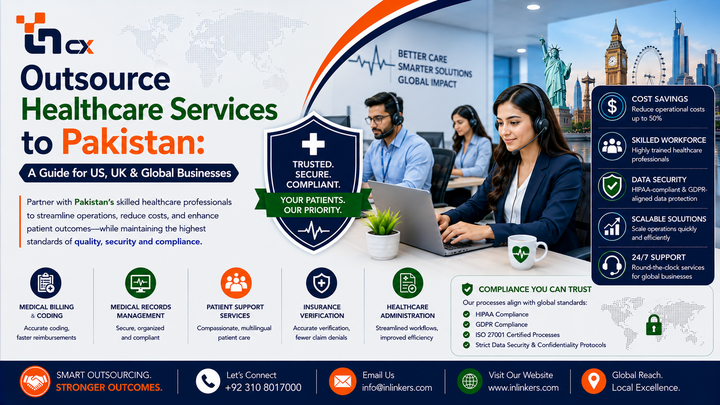
A healthcare organizations across the US, UK, Canada, Australia and other international markets are increasingly exploring outsourcing to improve operational efficiency, manage administrative workloads and access specialized professionals. Healthcare providers, payers, health-tech companies and medical organizations often handle large volumes of billing, coding, transcription, scheduling, patient support and revenue cycle activities.
Outsourcing these functions to Pakistan can provide access to trained professionals while helping organizations manage operational costs. InLinkers CX's healthcare outsourcing model supports medical billing, coding, transcription, revenue cycle management, patient support and related healthcare processes. The company states that healthcare outsourcing can provide potential savings of 50–65% compared with domestic operations, depending on the service and engagement structure.
Why Outsource Healthcare Services to Pakistan?
Healthcare businesses face increasing administrative demands. While doctors, nurses and other clinical professionals focus on patient care, administrative teams handle important processes such as insurance verification, claims processing, appointment scheduling, documentation and billing.
Maintaining a large internal administrative workforce can increase recruitment, training, technology, infrastructure and management expenses.
Pakistan offers an expanding outsourcing industry with professionals serving international businesses. Healthcare organizations can use outsourcing to build dedicated teams around specific operational requirements.
Commonly outsourced healthcare functions include:
-
Medical billing
-
Medical coding
-
Revenue cycle management
-
Medical transcription
-
Patient scheduling
-
Insurance verification
-
Prior authorization
-
Denial management
-
Healthcare data entry
-
Patient support
-
Telehealth support
The right outsourcing partner can provide specialized teams while following client-specific workflows, quality standards and security requirements.
What Is Healthcare BPO?
Healthcare BPO refers to outsourcing non-clinical healthcare business processes to a specialized external provider. Instead of managing every administrative function internally, healthcare organizations can assign selected processes to trained outsourcing professionals.
Healthcare BPO can cover both back-office and patient-facing activities.
Back-office services may include billing, coding, claims processing, transcription, data entry and revenue cycle management. Patient-facing services may include appointment scheduling, insurance verification, general inquiries and telehealth support.
The objective is not simply to reduce costs. A well-structured healthcare BPO operation should improve consistency, turnaround time, scalability and administrative efficiency while maintaining appropriate security and quality controls.
Medical Billing Outsourcing
A perfect medical billing services are among the most commonly outsourced healthcare functions.
Medical billing involves several processes that can require significant administrative resources, including:
-
Claims submission
-
Payment posting
-
Insurance verification
-
Denial management
-
Accounts receivable follow-up
-
Billing inquiries
-
Claim status tracking
-
Payment reconciliation
A dedicated medical billing team can work according to a healthcare organization's payer requirements, workflows, systems and reporting standards.
InLinkers CX lists medical billing and accounts receivable support as part of its healthcare outsourcing offering, with billing specialists handling claims submission, payment posting, denial management and AR follow-up.
Medical Coding Services
Medical coding requires specialized knowledge because patient records must be translated into appropriate coding systems.
Common coding systems include ICD-10, CPT and HCPCS. Experienced coding professionals can help healthcare organizations process documentation accurately and efficiently.
When outsourcing coding, organizations should verify the qualifications of the professionals assigned to the account. InLinkers CX states that reputable healthcare BPO operations may employ AAPC- or AHIMA-credentialed professionals for specialized coding work.
Client-side verification of credentials and sample audits can provide additional assurance before production work begins.
Revenue Cycle Management
Revenue cycle management combines multiple financial and administrative processes associated with healthcare services.
An RCM team may support:
-
Eligibility verification
-
Prior authorization
-
Medical coding
-
Claims submission
-
Payment posting
-
Denial management
-
Accounts receivable
-
Insurance follow-up
Instead of outsourcing each function separately, healthcare organizations can use an integrated RCM team to manage several connected processes.
This can improve coordination between billing, coding, claims and payment activities.
Medical Transcription and Documentation
Healthcare organizations generate significant volumes of clinical documentation. Medical transcription services can help convert dictated or recorded information into structured written documentation.
Outsourced transcription teams can support:
-
Clinical notes
-
Medical reports
-
Dictation-to-text services
-
EHR documentation
-
Healthcare records
Accuracy and turnaround time are particularly important in this area because documentation can become part of a patient's medical record.
Organizations should establish quality-control procedures and regularly review transcription accuracy.
Patient Support and Scheduling
Healthcare outsourcing is not limited to back-office work.
Patient support teams can assist with:
-
Appointment scheduling
-
Appointment reminders
-
Insurance verification
-
Prescription refill coordination
-
General inquiries
-
Follow-up communication
-
Patient portal assistance
These functions can help healthcare organizations maintain responsive communication while allowing clinical teams to focus on patient care.
Telehealth Support
The growth of telehealth has created new administrative and technical support requirements.
Outsourced teams can assist patients with appointment coordination, platform navigation, basic technical issues, insurance verification and post-visit follow-up.
Telehealth support requires more than general customer service skills. Agents should understand healthcare terminology, patient communication standards and the specific telehealth platform being used.
HIPAA Considerations for US Healthcare Organizations
For US healthcare organizations, data protection is one of the most important considerations when selecting an outsourcing provider.
HIPAA requirements apply to protected health information and the organizations and service providers handling it. Businesses should therefore verify how an outsourcing partner protects PHI rather than relying only on general claims of compliance.
Important safeguards can include:
-
Role-based access
-
Encrypted data transmission
-
Secure data storage
-
Activity and audit logging
-
Employee confidentiality agreements
-
Security training
-
Documented breach procedures
-
Appropriate contractual agreements
InLinkers CX states that its healthcare engagements use jurisdiction-appropriate data agreements and role-based access controls before patient information is shared.
US organizations should conduct their own legal and compliance assessments before transferring PHI.
UK Healthcare Outsourcing and Data Protection
UK healthcare organizations have additional considerations when working with an overseas provider.
UK GDPR and NHS-related security requirements should be addressed when patient information is processed outside the UK. Pakistan is outside the UK's adequacy framework, meaning appropriate safeguards for international data transfers may be required.
Healthcare organizations should determine the correct contractual and legal mechanism for their specific arrangement and verify the provider's security procedures.
InLinkers CX highlights UK healthcare considerations including NHS DSPT-aligned practices and appropriate international transfer safeguards.
Global Healthcare Outsourcing
Healthcare organizations outside the US and UK may have different privacy and data-protection requirements.
For example, businesses may need to consider:
-
GDPR requirements in the European Union
-
PIPEDA requirements in Canada
-
Privacy Act requirements in Australia
-
PDPL requirements in relevant GCC markets
The outsourcing provider should be able to understand the client's jurisdiction and establish appropriate contractual and operational safeguards.
A generic "GDPR compliant" statement is not enough. Businesses should request specific documentation and review the provider's actual security practices.
Benefits of Healthcare Outsourcing to Pakistan
Cost Efficiency
Outsourcing can reduce some staffing and infrastructure expenses compared with building equivalent domestic teams.
Skilled Professionals
Businesses can access professionals trained in billing, coding, transcription, patient support and other healthcare processes.
Scalability
Teams can be expanded or adjusted according to workload and business requirements.
Faster Operations
Dedicated teams can help healthcare organizations process administrative work more efficiently.
Focus on Patient Care
Outsourcing administrative functions allows healthcare providers to dedicate more internal resources to clinical and patient-facing priorities.
24/7 Support
Depending on the engagement, offshore teams can provide extended operational coverage across different time zones.
How to Choose a Healthcare BPO Partner
Healthcare organizations should carefully evaluate potential providers before transferring sensitive information.
Important questions include:
-
Where will employees work?
-
How is access to patient information controlled?
-
What security procedures are in place?
-
Are employees trained in healthcare data handling?
-
Can professional credentials be verified?
-
What quality metrics are monitored?
-
How are incidents reported?
-
Is there a backup team member for critical roles?
-
Can the client interview assigned specialists?
-
Can the provider provide appropriate contractual documentation?
A provider should be able to answer these questions clearly and provide supporting documentation.
Healthcare-Specific Quality Assurance
Quality assurance is especially important in healthcare because errors can have financial, operational and patient-related consequences.
Healthcare organizations should monitor metrics such as:
-
Claim accuracy
-
Denial rates
-
Transcription error rates
-
Processing turnaround time
-
Patient-support quality
-
First-contact resolution
-
Productivity
-
Compliance performance
InLinkers CX recommends healthcare-specific KPIs rather than relying exclusively on generic call-center measurements.
Why InLinkers CX?
InLinkers CX is a Pakistan-based BPO provider with a dedicated healthcare vertical serving organizations across international markets. Its healthcare services include medical billing, coding, transcription, revenue cycle management, patient support and related administrative functions.
The company states that healthcare teams can be operational within approximately 14 days, depending on requirements and emphasizes credential verification, jurisdiction-appropriate agreements, role-based access and healthcare-specific reporting.
Final Thoughts
Outsourcing healthcare services to Pakistan can help US, UK and global healthcare organizations improve administrative efficiency, access specialized professionals, scale operations and manage costs.
From healthcare BPO and medical billing services to coding, transcription, RCM, patient scheduling and telehealth support, healthcare organizations can outsource a wide range of non-clinical processes.
However, healthcare outsourcing should never be treated as a simple cost-saving exercise. Data protection, security, professional qualifications, quality assurance, contractual safeguards and jurisdiction-specific compliance should all be evaluated before an engagement begins.
With the right partner, clearly defined processes, trained specialists, appropriate security controls and consistent quality monitoring, Pakistan can serve as a scalable delivery location for healthcare organizations seeking reliable administrative support and long-term operational efficiency.