How Cutting Speed and Feed Rate Affect Industrial Tool Life
Posted by Khokhawala Trading
Filed in Other 23 views
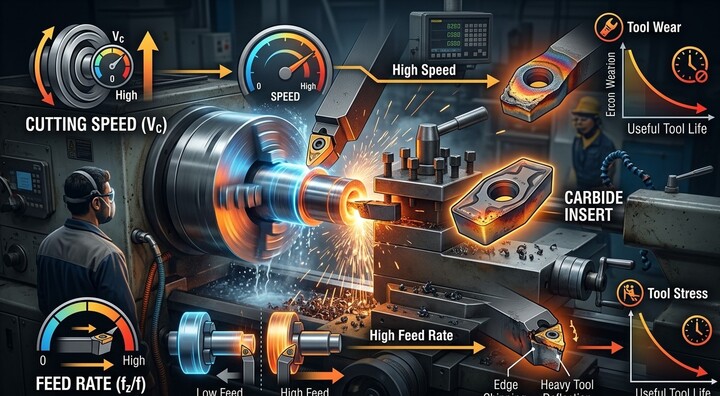
In modern manufacturing, machining efficiency depends heavily on choosing the right cutting conditions. Among the most important parameters are cutting speed and feed rate, which directly influence industrial tool life, machining accuracy, surface finish, productivity, and operating costs. When these parameters are correctly selected, cutting tools can perform consistently for longer periods. When they are too aggressive or poorly matched to the application, tools can experience premature wear, overheating, chipping, or even sudden failure.
For manufacturers and engineering workshops, understanding the relationship between cutting speed, feed rate, workpiece material, and tool performance is essential. Khokhawala Trading LLC, an experienced Industrial Tools Supplier in Dubai, supports industrial and machining applications with a wide range of cutting tools, carbide tooling, machining accessories, and precision equipment.
This guide explains how cutting speed and feed rate affect tool life and provides practical considerations for improving machining performance.
What Are Cutting Speed and Feed Rate?
Cutting speed and feed rate are two fundamental machining parameters. Although they work together, they describe different aspects of the cutting process.
Cutting Speed
Cutting speed refers to the relative speed between the cutting edge and the surface of the workpiece at the point of contact. It is commonly expressed in meters per minute (m/min) or surface feet per minute (SFM).
Cutting speed influences:
- Cutting temperature
- Friction
- Tool wear
- Material removal rate
- Surface finish
- Productivity
A higher cutting speed generally increases productivity, but excessive speed can generate more heat and accelerate tool wear.
Feed Rate
Feed rate refers to how quickly the cutting tool advances through or across the workpiece. Depending on the machining operation, it may be expressed as mm/min, mm/revolution, or feed per tooth.
Feed rate affects:
- Chip thickness
- Cutting forces
- Surface finish
- Material removal
- Tool loading
- Tool life
An appropriate balance between cutting speed and feed rate is necessary for efficient and stable machining.
Why Cutting Parameters Matter for Tool Life
Every cutting tool has operating conditions within which it can perform effectively. Tool manufacturers typically provide recommended cutting ranges based on tool material, geometry, workpiece material, and machining operation.
Operating outside these ranges can cause accelerated wear.
For example, excessive cutting speed can increase temperature at the cutting edge. Excessive feed rate can increase mechanical loading and cutting forces.
Both situations can shorten tool life, but they do so through somewhat different mechanisms.
How Cutting Speed Affects Tool Life
Cutting speed has a particularly strong relationship with tool temperature and wear.
As cutting speed increases, the cutting edge generally experiences higher thermal loads. If the tool cannot withstand the resulting temperature, wear can accelerate rapidly.
Common forms of wear caused or accelerated by excessive cutting speed include:
- Flank wear
- Crater wear
- Edge rounding
- Thermal cracking
- Plastic deformation
- Coating deterioration
Excessive Cutting Speed
When cutting speed is too high, excessive heat can build up around the cutting zone. This can soften certain tool materials, degrade coatings, and accelerate wear.
The result may be shorter tool life despite an initially faster machining cycle.
Cutting Speed That Is Too Low
Very low cutting speeds are not automatically beneficial. Depending on the material and tooling, insufficient cutting speed can sometimes contribute to rubbing, built-up edge, poor surface finish, and inefficient production.
The goal is therefore not simply to minimize cutting speed. It is to identify an appropriate operating range.
How Feed Rate Affects Tool Life
Feed rate primarily influences mechanical loading on the cutting edge.
Increasing feed generally increases chip thickness and cutting forces. If the feed is too high for the selected tool, the cutting edge can become overloaded.
Potential consequences include:
- Edge chipping
- Tool breakage
- Excessive vibration
- Poor surface finish
- Increased spindle load
- Accelerated wear
However, an excessively low feed rate can also cause problems.
When feed is too low, the cutting edge may rub against the material rather than efficiently removing a properly sized chip. This can generate heat and contribute to premature wear.
Therefore, both extremely high and extremely low feed rates can negatively affect tool performance.
The Relationship Between Cutting Speed and Feed Rate
Cutting speed and feed rate should not be considered independently.
A change in one parameter can affect the overall cutting conditions.
For example, increasing cutting speed while maintaining the same feed may increase thermal loading. Increasing feed while maintaining the same cutting speed can increase mechanical loading.
The best machining results usually come from balancing:
- Cutting speed
- Feed rate
- Depth of cut
- Tool geometry
- Workpiece material
- Tool material
- Machine rigidity
- Coolant or lubrication
This balance helps maintain a stable cutting process.
Effect on Carbide Cutting Tools
Carbide cutting tools are widely used in CNC machining because of their hardness, wear resistance, and ability to operate at relatively high cutting speeds.
However, carbide does not mean that a tool can be operated at unlimited speeds.
Incorrect cutting conditions can still cause:
- Cutting-edge chipping
- Thermal cracking
- Excessive flank wear
- Crater wear
- Premature tool failure
Carbide grades and geometries are designed for different applications. A carbide tool selected for aluminum may require different cutting conditions than one designed for stainless steel or hardened steel.
Following tooling manufacturer recommendations is therefore essential.
Effect of Workpiece Material
The workpiece material has a major influence on cutting parameters.
Steel
Different steel grades have different hardness and machinability characteristics. Cutting conditions should be adjusted according to the specific grade.
Stainless Steel
Stainless steel can generate significant heat and may work-harden if machining conditions are poor. Proper cutting speed, feed, and coolant management are important.
Aluminum
Aluminum generally allows higher cutting speeds, but proper tool geometry and chip evacuation are essential to prevent built-up material on the cutting edge.
Cast Iron
Cast iron can be abrasive, which can increase tool wear. Tool grade and cutting conditions should account for this characteristic.
Hardened Materials
Hardened steels and other difficult-to-machine materials often require specialized industrial cutting tools, appropriate coatings, and carefully controlled machining parameters.
Effect of Depth of Cut
Depth of cut is another important parameter that interacts with speed and feed.
A heavy depth of cut increases the amount of material being removed and can significantly increase cutting forces.
During heavy roughing operations, the tool must be capable of handling the increased load. During finishing operations, lighter cuts are commonly used to achieve the required dimensional accuracy and surface finish.
When changing depth of cut, cutting speed and feed may also need to be adjusted.
How Improper Parameters Accelerate Tool Wear
Incorrect cutting conditions can produce different types of tool damage.
Excessive Heat
Too much cutting speed can increase temperature and accelerate thermal wear.
Excessive Mechanical Load
Too much feed or depth of cut can overload the cutting edge.
Vibration and Chatter
Poor parameter combinations can cause unstable cutting, which may damage the tool and workpiece.
Built-Up Edge
Certain materials can adhere to the cutting edge when cutting conditions are unsuitable, affecting both tool life and surface finish.
Edge Chipping
Excessive mechanical shock, interrupted cuts, or unsuitable feed conditions can cause carbide cutting edges to chip.
Understanding these failure modes helps operators identify whether cutting parameters need adjustment.
The Role of Coolant and Lubrication
Coolant can help control heat and improve chip evacuation. Depending on the application, manufacturers may use flood coolant, cutting oil, minimum quantity lubrication, or dry machining.
Proper coolant application can help:
- Reduce cutting temperature
- Improve surface finish
- Reduce friction
- Remove chips
- Protect the cutting edge
However, coolant should be selected and applied according to the tool and workpiece requirements. In some machining applications, incorrect coolant use or thermal shock can negatively affect certain tools.
Machine Rigidity and Tool Holding
Cutting parameters cannot be selected separately from machine conditions.
A rigid machine, secure workholding system, and accurate tool holder can support more stable machining.
Excessive tool overhang, poor workholding, or high runout can cause vibration even when cutting speed and feed rate are theoretically correct.
Reliable chucks, vises, tool holders, and machining accessories can therefore contribute to better tool performance.
How to Optimize Cutting Speed and Feed Rate
A practical optimization process can help workshops improve tool life without sacrificing productivity.
Step 1: Identify the Workpiece Material
Determine the exact material and, where relevant, its hardness or grade.
Step 2: Identify the Tool
Check the tool material, geometry, diameter, coating, and manufacturer's recommended operating range.
Step 3: Start With Recommended Parameters
Use the manufacturer's recommended cutting speed and feed as the starting point.
Step 4: Monitor Machining Conditions
Observe:
- Cutting sound
- Surface finish
- Spindle load
- Chip formation
- Tool temperature
- Tool wear
Step 5: Make Controlled Adjustments
Change one parameter at a time where practical so that the effect can be evaluated.
Step 6: Record Results
Document tool life, machining time, surface quality, and production output.
This data can help workshops establish optimized parameters for repeat production.
Signs That Cutting Speed May Be Too High
Operators may notice:
- Rapid tool wear
- Excessive heat
- Discoloration
- Coating failure
- Poor surface finish
- Premature edge failure
These signs may indicate that cutting speed should be reduced or that a more suitable tool grade or cooling strategy is required.
Signs That Feed Rate May Be Too High
Potential warning signs include:
- Excessive cutting forces
- Chipped cutting edges
- High spindle load
- Poor surface finish
- Vibration
- Tool breakage
In such cases, feed rate may need to be reduced or the tool and machining setup reassessed.
Measuring Tool Life
Tool life should be measured using consistent criteria.
Possible tool-life indicators include:
- Number of components produced
- Cutting time
- Material removed
- Dimensional accuracy
- Surface finish
- Amount of flank wear
For high-volume production, monitoring tool life can help determine the optimum replacement interval.
Replacing a tool too early wastes tooling capacity, while replacing it too late can result in rejected components and unexpected failures.
Importance of Precision Measurement
Optimizing cutting conditions is not only about extending tool life. The final component must also meet its required specifications.
Precision measuring tools such as micrometers, calipers, dial indicators, bore gauges, and other inspection instruments can be used to monitor dimensional changes during production.
If dimensions begin moving outside acceptable limits, this may indicate tool wear or a change in machining conditions.
Working with a reliable Precision Measuring Tools Supplier in Dubai can help workshops establish suitable measurement capabilities for their manufacturing requirements.
Common Mistakes to Avoid
Workshops should avoid several common mistakes when setting cutting parameters.
Using Generic Settings
Different materials and tools require different operating conditions.
Increasing Speed Only to Improve Productivity
Higher speed may reduce cycle time but can also significantly reduce tool life if excessive.
Ignoring Tool Wear
A worn tool changes the effective cutting geometry and may produce increasingly inconsistent results.
Changing Multiple Parameters at Once
Changing speed, feed, depth of cut, coolant, and tooling simultaneously makes it difficult to identify the cause of a performance change.
Ignoring Machine Condition
Poor rigidity or tool runout can undermine otherwise suitable cutting parameters.
Benefits of Optimized Cutting Parameters
Properly optimized cutting speed and feed rate can provide several benefits:
- Longer industrial tool life
- Improved machining productivity
- Better surface finish
- Reduced tool replacement costs
- Lower scrap rates
- More consistent dimensions
- Reduced machine downtime
- Improved CNC machining efficiency
The objective is to find the best balance between production speed, tool life, quality, and total operating cost.
Conclusion
Cutting speed and feed rate are two of the most influential parameters affecting industrial tool life. Cutting speed primarily affects thermal loading and wear, while feed rate has a strong influence on cutting forces and mechanical stress. When these parameters are correctly balanced with tool material, geometry, workpiece material, depth of cut, machine rigidity, and coolant conditions, manufacturers can achieve better productivity and longer tool life.
For businesses seeking reliable machining and workshop solutions, Khokhawala Trading LLC is an established Industrial Tools Supplier in Dubai, offering industrial cutting tools, carbide tooling, machining accessories, precision measuring tools, and other engineering solutions. By combining suitable tooling with optimized cutting parameters and regular tool monitoring, workshops can improve machining accuracy, reduce operating costs, and achieve more consistent production performance.